
Doug’s Buddy’s Pedal Wrench Hack

Jim’s Tech Talk
By Jim Langley
If you work on your bikes – and I bet most of you do – you’ve surely been faced with a job that would have been easier to perform if you’d had a better tool. When that happens you might be able to head down to your local bike shop to buy that better tool.
Or, if you don’t have an LBC, you might be forced to use the closest thing you’ve got, improvising to solve the problem your own way. That’s what happened to Doug’s friend. I’ll let Doug tell you about it. Here’s his email:
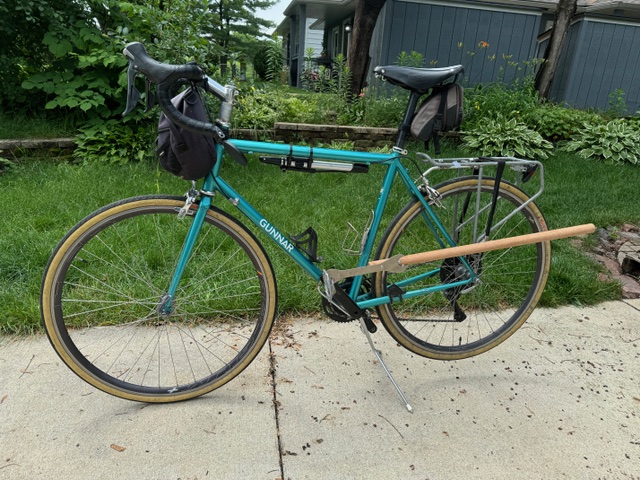
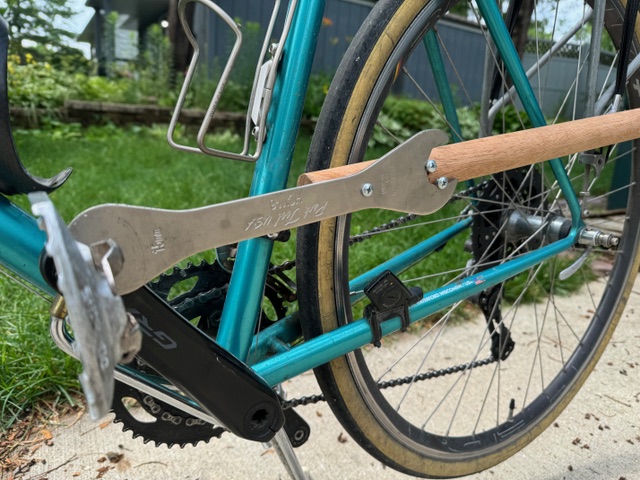
“As you know, pedal removal isn’t always easy and it’s hard to put a cheater bar on a typical flat pedal wrench. Here are some photos of one handy answer a friend made.”
Pedal Tools
Doug’s friend’s hack pics are below. But first let’s look at a few common types of pedal wrenches. Two things to know about pedal wrenches are that they feature a thinner wrench because the wrench flats on pedals are usually so thin that standard wrenches won’t fit. And, pedal wrenches are longer than standard wrenches to provide more leverage which can be important for removing stuck pedals.
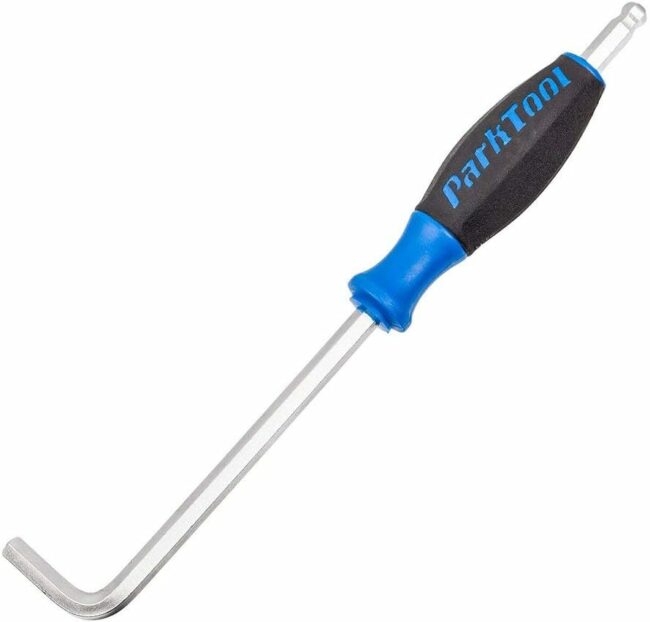
To be clear, we’re talking about wrenches for pedals with wrench flats. There are also pedals that go on and come off with a 6 or 8mm Allen wrench. For those you can use a standard Allen key or go with an Allen key pedal wrench such as Park Tool’s.
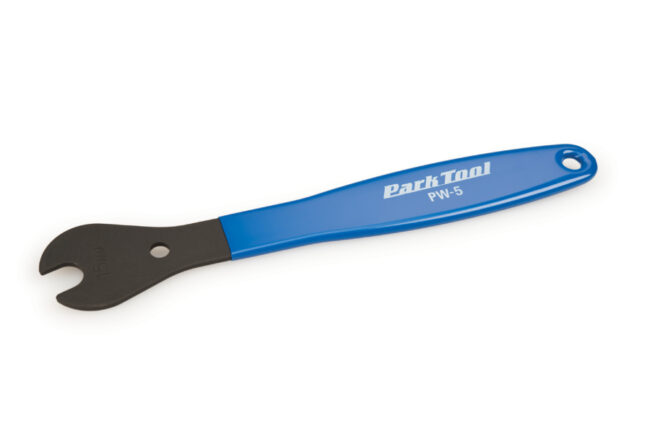
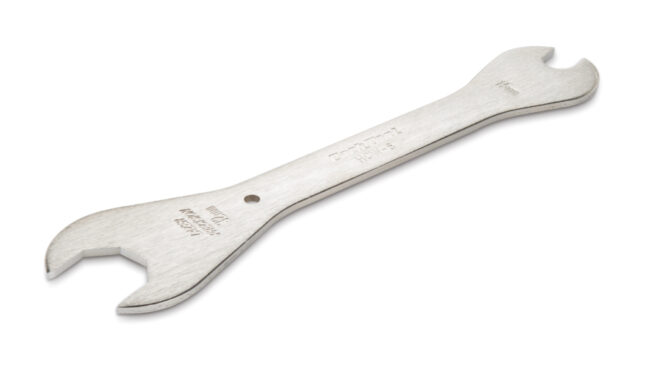
Here are three standard type pedal wrenches from Park tool. Notice that the two flat wrenches are thin along their entire length. One has a vinyl dipped handle to add a little protection. But, being thin means they can hurt your hands if you need to put a lot of force on the wrench trying to get off pedals.
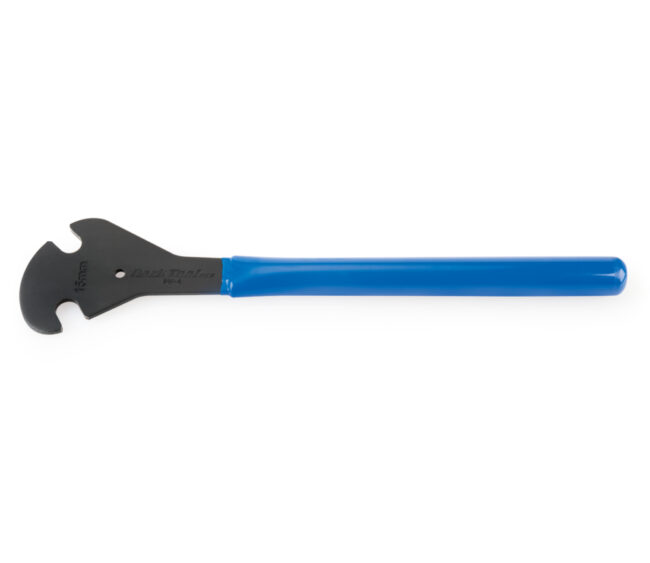
What makes the job a lot easier and saves your hands too is an extra long wrench featuring a round handle, such as Park’s PW-4 Professional Pedal Wrench (3rd photo). It makes removing pedals an easy, safe task.
Park Tool pedal wrenches mentioned:
- PW-5 Home Mechanic Pedal Wrench
- HCW-6 Headset/Pedal Wrench (now discontinued but what Doug’s friend had)
- HT-6 6MM Hex Pedal Wrench
- HT-8 8MM Hex Pedal Wrench
- PW-4 Professional Pedal Wrench
Doug’s Friend’s Hack
Since he only had the flat type pedal tool, Walt’s friend came up with a clever workaround. He securely attached his pedal wrench to a long pole. This provided plenty of oomph to get the pedals off while protecting his hands nicely too. Check it out.
Keep the hacks, tips and tricks coming!
Thanks for sharing your friend’s pedal wrench hack Doug! We’re always happy to pass along readers’ tips, tricks and hacks.
Jim Langley is RBR’s Technical Editor. A pro mechanic & cycling writer for more than 40 years, he’s the author of Your Home Bicycle Workshop in the RBR eBookstore. Tune in to Jim’s popular YouTube channel for wheel building & bike repair how-to’s. Jim’s also known for his cycling streak that ended in February 2022 with a total of 10,269 consecutive daily rides (28 years, 1 month and 11 days of never missing a ride). Click to read Jim’s full bio.

Who was the sadistic @#%$ that decided wrench flats needed to be replaced with Allen sockets? Even with the big Park Allen wrenches, it seems like part of the bike is in the way (even when the bike is off the floor)…
I agree. I just got a pair from OneUp that are Allen-only. Looks like an 8mm which I never carry.
BTW I use a lighter dead-blow hammer to loosen tight pedals. But I have been known to jump up and down on them too.
Another hack that I’ve used is a length of pvc pipe, You need a diameter not too much bigger than the handle of the wrench. Just slide it over the wrench and go to work
The biggest problem I’ve had over the years has been stripping the wrench jaws (or lands on hex wrench. Avoid cheap wrenches at all costs! I find hex sockets (1/4 or 3/8″ drive) easier to use than traditional Allen wrenches on pedals with those connections. Not a bad idea to clean those pedal threads periodically to keep ’em from getting ‘frozen’.
Leverage is nice, but biggest problem I’ve had with pedal removals has been stripped wrench jaws (or Allen heads). Use QUALITY tools. Cheap wrenches just strip & can damage your bike & pedals. FWIW- I prefer 3/8″ drive hex sockets over Allen wrenches. for pedals using those. And periodically unscrew & clean those pedal threads to avoid the dreaded ‘frozen pedal syndrome’.
I agree. Allen wrench removal of pedals is more problematic than using the flat wrench. I have both but the last time I tried using Allen I had difficulty with keeping the tip firmly in the hole leading to wallowing of hole and Allen key. Flat wrench is much better.
if you remove the pedals once a year while you’re performing annual maintenance and put good waterproof grease on the threads you’ll never need an extra long wrench to remove the pedals.
Yellow flag! Just in case there are some newbies reading and thinking Yeah, a new tool plus a cheater bar, I can do that! Please please please be advised: the left pedal is REVERSE threaded (clockwise to remove). You could have the best tool plus a six foot lead pipe cheater bar and never get the pedal off (and likely wreck the pedal and/or crank in the process.) Jes’ sayin’.
Thanks for that reminder, I knew that but forgot which side was a LHT! I actually had pedals unscrew while riding, after years of use. I saw it happen to a friend riding in front.. I don’t see how that is possible.
Prevention & resolution of this problem:
ALWAYS clean and grease pedal male threads and crankarm female threads.
New bikes, old bikes used bikes…everything.
Clean out the allen key area in pedal spindle before using tool; full depth engagement minimizes tool slippage. Never use Bondhus end for final tightening. Check the allen tool end is flat & square; file it if not.
For all the ‘long handle’ tools shown tighten while choking up on handle; use full length to loosen.
Secure the opposite crankarm to chainstay with toestrap and wheels on the floor; torquing on bike pictured as is will severely stress the lightweight stand particularly with the ‘cheater’ shown.
Put some “Never Seize” lubricant on the threads before installing pedal. And don’t over-tighten!
I lay down a moving blanket and turn bike upside down. Then use Park Tool #SWB-15 – Drive Breaker Bar. Before applying pressure, I confirm that spinning crank arm that I’m moving backwards.
When installing pedal, I grease threads and follow proper torque setting.
https://www.parktool.com/en-us/blog/repair-help/torque-specifications-and-concepts
Think the biggest problem is knowing which way each one comes off. Easy. Both pedals screw off toward the back of the bike, tighten to the front.
You have to specify that the wrench is *above* the pedal; if it’s below, the opposite is true.
In a similar vein, when a direction of turning is mentioned (“clockwise” vs “counter-clockwise”), it’s a good idea to say “looking down on the fastener”, because if you are on the other side of the fastener it’s the reverse.
(/pedant mode) 😉
I use a Hozan pedal wrench. That thing is beefy and has more contact area than most. For really frozen pedals I remove the crank arm and carefully clamp it in a vice lengthwise wrapped a couple times in a rag to avoid marring the arm.
More leverage is your friend.
Nice. of Park Tool to include the screw hole for attaching the wrench to the long handle.
I know a lot of folks with the HCW-6. Park must have sold quite a few. Wonder why it was discontinued?
For thin wrenches like cone wrenches or pedal wrenches, I wrap the handles with leftover handlebar tape or the like to take the bite out of the thin edges.
A few years ago I was experimenting with different pedals so I’ve learned to not over-tighten my pedals. Shimano says 10Nm on their pedals. Even after being on my bike for a couple of years, I was able to easily remove my pedals when my wife and I to try them.
Don’t forget that pedals are threaded in such a way as to loosen if the spindles sieze. Over tightening may defeat this safety feature.
I’ve used a pneumatic impact wrench to remove frozen pedals.
A simple hack to remove pedals (works for BB also). put the bike on the tires. I place block of wood under the crank arm so you just push DOWN to remove the pedal. Block goes to the front of the bike for removal (both sides!) or to the rear for installation. (not too tight!!)
I also use a hex key on a 3/8 breaker bar or long ratchet. For REAL problems, slip a piece of plastic pipe over the handle for more leverage. If you need to do this, you failed previous maintenance – lesson learned.