
Is Internal Cable/Hose/Wire Routing a Bad Thing?

Jim’s Tech Talk
By Jim Langley
In response to the story last week about my new road bike, a 2026 Cervelo R5, two readers commented about the bike’s internal hose routing, as follows:
“Hiding hoses/wires – Meh. Two-edged sword that can make maintenance/repairs a PITA.”
And
“The aesthetics of integrated cable routing comes with an extra cost, that particular agony of shoving hoses and wires through headset spacers a job even the best bike mechanics hate.”
I agree, but…
Internal cable routing is an interesting subject, so I wanted to explain how it works on this new bike and also talk a little about how and why it’s been used on bicycles going back many years.
The new Cervelo R5
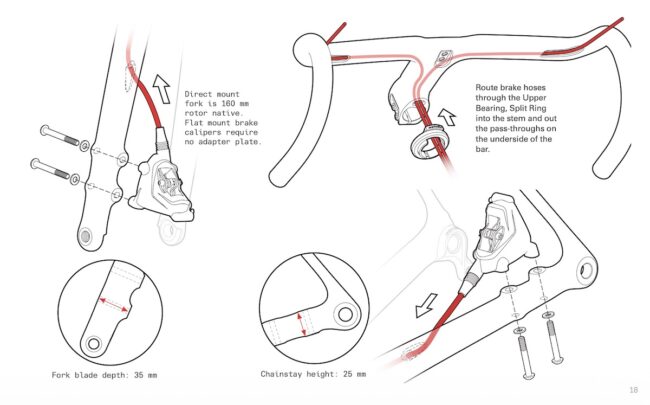
One of the reasons I chose the Cervelo R5 model built with SRAM Force AXS eTap components (instead of Shimano Ultegra Di2) is because SRAM uses a wireless system, which means there are no wires inside the frame.
What is inside the handlebars, stem, fork and frame on this bike are the hydraulic hoses for the disc brakes. Because it’s only these two hoses, it’s easier to route them internally than it is routing wires and hoses (they want to get in the way of each other and jam).
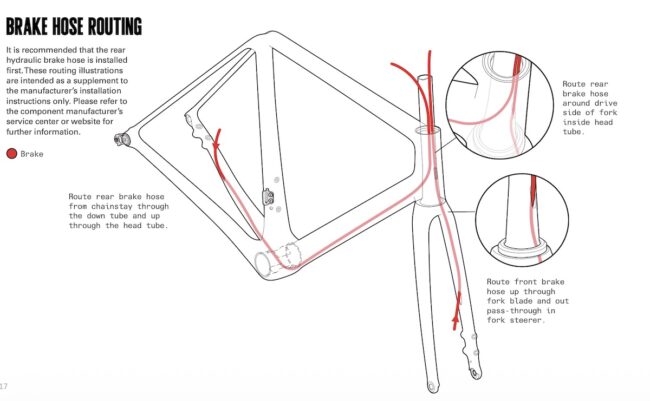
I think it’s pretty ingenious how the hoses pass through the bike. Since they’re hidden on my bike, I can’t take any photos to show you but I can share these diagrams from the assembly instructions (the red lines represent the hoses). It might look like the hoses couldn’t work when forced through the stem and down the fork the way they are (look at the small hole beneath the handlebar).
You might think they’d make it difficult to turn the handlebars to steer. But, the hydraulic hoses are actually made to twist like this, and you don’t feel resistance at all. Which is counterintuitive, especially if you’ve experienced a standard externally routed rear brake or shift cable housing (or both) that want to push and turn the front wheel when you’re walking your bike.
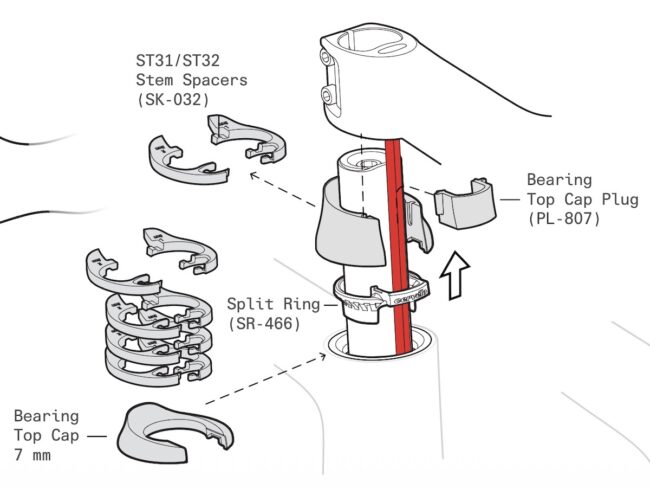
Note that, regarding the headset spacers used to set the stem height, they actually come apart. This means that you can slip them on and off if you need to make changes, without having to deal with the hoses. So Cervelo did address that issue.
Hose care and noise prevention
As for maintenance of the hoses, to protect them from wear and tear inside the frame, companies, such as Jagwire, make what’s basically small diameter foam pipe insulation (similar to what might be on your plumbing) that you slip over the hydraulic hoses during installation: Internal Housing Damper.
This does two things. It keeps the hoses from making noises rattling against the frame when you’re on rough terrain and it protects the hoses from any abrasion caused by contact with the frame, fork, bars or stem.
Routing tip
Even with only hoses, it’s not easy or fast to route them. The tight bends inside handlebars and stems are usually more challenging than the hollows inside frames and forks. For this I use Park Tool’s Internal Cable Routing Kit IR-1.3.
It comes with multiple feeding lines to pull through the path you’re using to get the hose/wire through and several ways to get these lines inside.
Once the line’s inside, it can be attached to the hydraulic hose or the wire or housing, etc., and you can then pull the line to get the hose/wire/housing into place inside the bike. Here’s Park’s video showing how the kit is used. I believe Park Tool invented this tool, and I know it’s been upgraded since it first came out so it works even better.
A little internal routing history
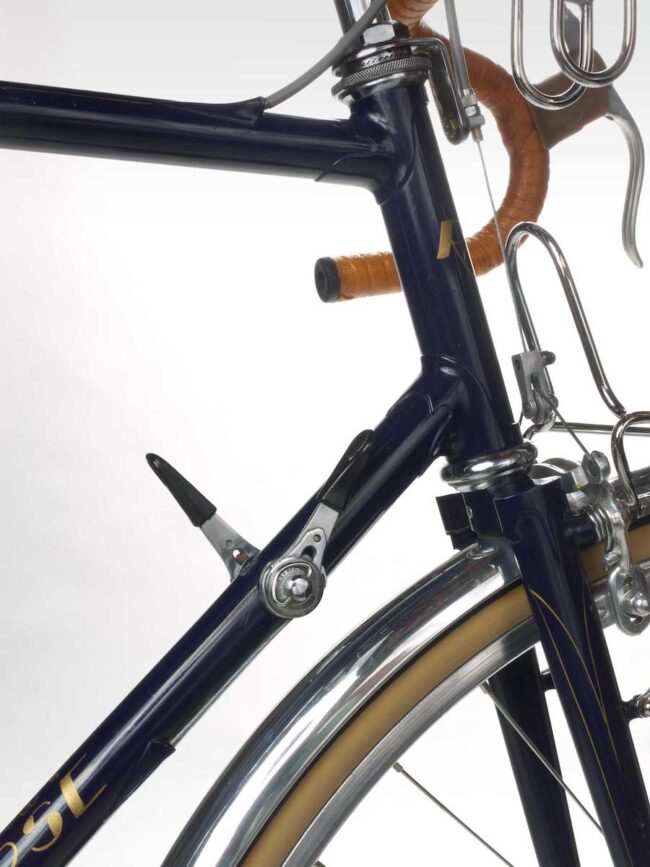
Here’s a close-up photo of my 1975 René Herse touring bicycle. The brake cable and shift cable are routed through the frame. It is reasonable to think it’s a silly idea to route cables this way, because if they break, it will be much more difficult to replace them than if they were routed externally. After all, for touring, the last thing you want is for basic maintenance to be more difficult.
The thing is that René Herse knew exactly what he was doing (and the other builders making bikes like this did too). The cables aren’t simply inside the hollow frame tubes, they’re actually inside small diameter tubes that run from end to end inside the frame! So, if you break a cable, all you have to do is push the new one through the frame, which is actually easier than dealing with some types of externally routed cables.
These bikes typically had wired lighting systems powered by generators rubbing on the wheel, too. For these, the electrical wires were also internally routed, through the frame, fenders and racks. This was done for a good reason too: by hiding the wires inside, they were protected and wouldn’t get cut accidentally, which can happen when they’re exposed outside along the frame tubes.
So, summing up, there’s more to internal housing than meets the eye — or, more correctly, than doesn’t meet it.
Jim Langley is RBR’s Technical Editor. A pro mechanic & cycling writer for more than 40 years, he’s the author of Your Home Bicycle Workshop in the RBR eBookstore. Tune in to Jim’s popular YouTube channel for wheel building & bike repair how-to’s. Jim’s also known for his cycling streak that ended in February 2022 with a total of 10,269 consecutive daily rides (28 years, 1 month and 11 days of never missing a ride). Click to read Jim’s full bio.