Is it okay to wear all black when cycling?

Question: I’ve been cycling on our area roads for a few years now, and for safety and to be seen by drivers, I always wear bright clothing. But I see quite a few local riders who wear dark colors, and a few who sometimes wear all black. What are they thinking? —Joan S.
RBR’S STAN PURDUM REPLIES: Their reasons, whether good ones or not, vary. Some prefer black because lube from the drive chain, once it touches your clothing, leaves an ugly smear that’s almost impossible to wash out, but it doesn’t show on black garments. Others have jerseys that had darker colors to begin with; they may have received these as participants in various bike events, and they like to wear them. Some simply are bored with fluorescent yellow-green jerseys despite the high-viz attributes of such garb. Cycling also has its share of rebels who do the opposite of conventional wisdom just because it is different. I’ve even heard some argue that black attire is just as visible as other colors in daylight, and while they don’t convince me, there is the reality that a distracted driver may not see you no matter what you are wearing.
A 2013 study from the United Kingdom tracked how drivers behaved when passing cyclists wearing various kind of clothing, including high-viz garments. Disappointingly, it found that the only apparel that made a consistent difference was a safety vest featuring a prominent mention of the word “police” and a warning that the rider was video-recording their journey.
Still, I’m convinced that the high-viz color does make us more noticeable since drivers are now used to people on the road, including highway construction workers, being clad in that fluorescent color, which now almost exclusively signals “human being ahead.”
I recall a cloudy day when I was riding with two friends. One was wearing a high-viz windbreaker and the other a medium-blue colored jacket. I was in the lead, and when I looked back, I could at first see only the rider in the bright-colored jacket, even though the cyclist in the blue was ahead of him.
What’s more, in 2017, The Wall Street Journal reported a study that found that cyclists wearing fluorescent colors or lights on their legs or feet — parts of the body that are in constant motion when riding — does make riders more noticeable to drivers. The idea is that riders’ upper bodies are relatively stationary, making the high-viz garments there less conspicuous. The WSJ article, from July 1, 2017, is behind a paywall, but Road Bike Rider included a report about it, which you can read here. And here’s an online WSJ video that demonstrates the information.
Other findings indicate the importance of blinking lights on bikes, both front (white) and rear (red), even in daylight. Or non-blinking lights strapped around one’s ankles. See the argument in favor of lights here.
My own practice is to generally wear brightly colored jerseys. My windbreaker and my rain jacket are both high-viz yellow-green. And I use blinking lights, front and rear, even in the daytime.
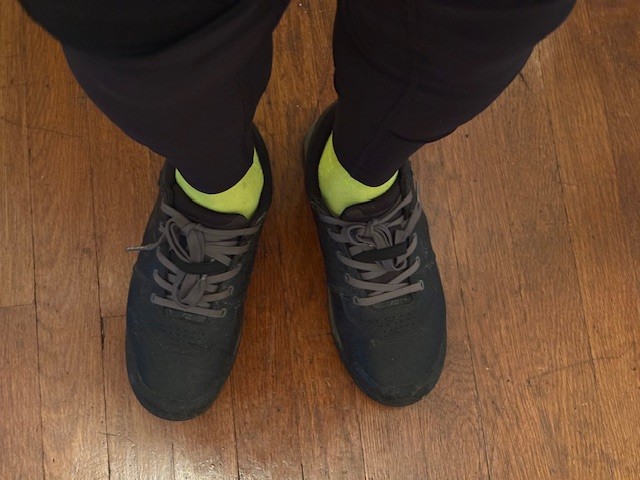
Right after the WSJ article was published, I bought a pair of leg warmers in high-viz yellow-green, which no doubt made me more noticeable on the road. But I almost immediately got chain grease on them, which was there to stay. But not only that, the bright fluorescence made me feel like a clown every time I wore them. When they finally wore out, I replaced them with a black pair. However, if I could have found warmers in black with a few reflective accents on them, I would have purchased those, but I couldn’t find any like that (maybe there’s an entrepreneurial opportunity there for somebody). But I often pair them with high-viz socks.
The one thing that riders can’t change is that drivers get distracted, whether they are looking at their phone, fiddling with the radio or just have their minds on other things besides the road ahead. But regarding what we cyclists wear and whether or not we use blinking lights, we shouldn’t make the work of seeing us any harder than it needs to be.
Stan Purdum has ridden several long-distance bike trips, including an across-America ride recounted in his book Roll Around Heaven All Day, and a trek on U.S. 62, from Niagara Falls, New York, to El Paso, Texas, the subject of his book Playing in Traffic. Stan, a freelance writer and editor, lives in Ohio. See more at www.StanPurdum.com.
In my case, at 6’2″ 300 lb (1.88m 136kg), it’s very difficult to find quality gear that isn’t black, especially bib shorts and tights. I’ve found some 3XL jerseys, in brighter colors, but it seems cycling marketing prefers to conceal fat riders in the dark lol
I wear Primal’s Prisma version
https://www.primalwear.com/products/green-mens-prisma-bibs?_pos=3&_sid=69a9d0f96&_ss=r&variant=33090673573968
Another reason for black clothing is it is warmer in the winter as it absorbs the heat from the sun and it doesn’t stay as dirty. It’s well known that the brain is very good at filtering out backgrounds and the primary thing that overcomes this is something that makes a strong temporal signal, ie flashing or moving lights. So the most important thing for visibility is to run bright random flashers front and rear during daylight and especially twilight hours and have reflective stripes on your moving feet. These are much more important than the color of the clothes.
Once I started using front and rear flashers, driver behavior noticeably improved. They gave me more room when they passed me and were less likely to make a left turn in front of me. When I look down the road I see bikes with flashers way before I see riders in bright colors.
Hmmm, I ride on our rural Maine coastal roads down into the mid teens F. I can’t say wearing a high visibility vest or jacket is an issue in keeping warm. It’s not difficult to insulate with a layer or two beneath. I’m more likely to become too hot from overdressing. The hands, and to a lesser degree feet, are the issue. Battery/electric gloves have been a godsend, and neoprene covers over the toe area of my socks, with a chemical heat pack on top of my foot between those layers, does the trick. I rarely resort to my winter boots. Rear flasher on my helmet, and on rear of the bike, always, but not a front flasher, as there is very little traffic here, and virtually zero cross traffic. The odds of someone wanting to make a turn in front of me are almost nil. I do have a small front headlight to deploy if I’m pushing daylight on our short winter days, but I try to avoid needing it.
I am a believer in wearing bright clothing and have been doing so for many years. The epiphany for me came when I had two close calls with cars in a single month. The common thread to these two incidents was that I was wearing black tights, a dark blue helmet, and a navy blue jacket. These close calls scared me sufficiently to change my cycling clothing to be more visible. I discovered a cycling clothing company Seemeware (https://seemewear.com/) that offers very visible attire and wear their jerseys for 90% of my riding. I have read that the movement of a bright object catches the eye of motorists so I usually wear brightly colored socks. A bright colored helmet is also part of my effort to be more visible. Finally I have bright flashing lights in both the front and rear of my bike. The thought of dressing so as to not look like a “clown” is a choice where one chooses fashion over safety. Since changing my attire I have not any incidents that compare to the two close calls that I referenced earlier in this post. Cycling on the road with cars can be dangerous and I believe being more visible mitigates some of that danger. I do still wear black shorts/tights as I need something black so I can wipe grease off my hands should I get greasy during a repair :-). My two cents.
All black is definitely stealth. Bright colors definitely stand out – especially on a bright day. Next to a helmet, the 2nd safest accessory is a bright FLASHING headlight. Third is a red flashing rear light. Here, outside Boston, where there are very few roads with bikleable shoulders, the front light is invaluable. We often see drivers coming from the right, either out of a driveway, or a side street, stop, then back up to let us know they see us. They are not looking for cyclist, only cars. The flashing light stands out. Flashing, not steady. A steady light looks like a motorcycle. Wear what you want on a bike, but use a flashing front light.
As an aside, what is worse than a cyclist in all black are people who walk in the evening or at night in all black – without any lights, especially on a heavily wooded street. I recently saw a man with a baby carriage that had 2 red flashing bicycle lights facing forward. I figured he must be a cyclist.
flashing taillights is most important……. NOT flashing headlights
All black is definitely stealth. Bright colors definitely stand out – especially on a bright day. Next to a helmet, the 2nd safest accessory is a bright FLASHING headlight. Third is a red flashing rear light. Here, outside Boston, where there are very few roads with bikeable shoulders, the front light is invaluable. We often see drivers coming from the right, either out of a driveway, or a side street, stop, then back up to let us know they see us. They are not looking for cyclist, only cars. The flashing light stands out. Flashing, not steady. A steady light looks like a motorcycle. Wear what you want on a bike, but use a flashing front light.
As an aside, what is worse than a cyclist in all black are people who walk in the evening or at night in all black – without any lights, especially on a heavily wooded street. I recently saw a man with a baby carriage that had 2 red flashing bicycle lights facing forward. I figured he must be a cyclist.
My experience as a driver is that front and rear blinking lights stands out much more than kit color. Sure, bright colors don’t hurt and probably help, but I’m guessing that’s a 5% improvement over lights alone.
The best place to put bright colors is on the ankles and knees, as the motion of the legs draws more attention than stationary bright colors.
For black kit (which I like the look of), I only wear it on the road if it’s reflective (that’s mostly a night-time benefit).
So far, no one has commented about lights for ankles and shoes. The video link you posted suggests that lights in motion can be very helpful. I am curious if readers are actually using these lights and where can they be found?
Also for night riding, I read sometime ago about lights on wheels being helpful for night riding. Is anyone using these.
Great point. I ride before dawn and I have seen many runners with lights on their shoes or lit up vests and sashes.
I haven’t seen cyclists doing this yet.
I have moved to exclusively wearing green or orange socks. Many years ago when I rode at night quite a bit, I had reflective bands that went around my ankles. I received many positive comments about their visibility at stop lights, so those worked quite well and led to my sock color choices for day time riding now. I suppose I could still wear the reflective bands in day time, but have not chosen to do so. Back when I was doing the night rides, I also had three rear blinking lights, one on the seat post and one clipped to each side jersey pocket. For my daytime rides, I now use a Garmin Varia in conjunction with a Sprintech drop bar mirror, as well as a Trek front blinking light (RT something).. This article has me thinking that I should look into reflective tape that I could add to the back of my cycling shoes. With our near constant bright sunlight in the AZ desert, that should have a benefit.
I have leg warmers from Aerotech that are black with reflective stripes/highlights. They are nicely fleeced on thei inside, have great silicon leg grippers that stick to my legs so well I peel them off after a ride, and were unbelievably inexpensive. High cost is definitely not always an indictor of quality!
Thanks for all the helpful comments!
All anyone has to do is to go to any home improvement place and you can buy a safety vest in neon, lime, yellow, or orange, get the ones with the wide reflective bands, these vests will set you back less than $20.
Concerning neon colors, the color lime and or yellow is not a good color to get when there is foliage in and around rural and forest, the green in nature mutes those two colors; orange is the best color in those situations. Orange is also more visible in broad daylight, but on dim overcast or foggy days, for some reason green and yellow show up better.
In todays world it is wise to ride a bike during the day with a very bright flashing front and rear light, when I say bright, both must be at least 300 lumens so the flash can be seen for over a mile away. That flashing will (hopefully) attract the attention of a person who might be texting and not watching the road much.
Folks, PLEASE! This is one of those conversations, like, “Is it OK to ride without a helmet?” and “Is it OK to ride against traffic?” Distracted, half-blind, drunk, stoned, texting, elderly, speeding, eating, chatting-on-the-phone drivers are bearing down on you at a high rate of speed (relative to you) in vehicles that could kill you instantly. Don’t you want to do EVERYTHING possible to be seen? Do you see crossing guards in black? HIghway workers? Any professionals that come within feet of moving vehicles? For Pete’s sake, even the guys who load the bags on the planes are decked out in orange. And it’s not just black that’s the culprit. Gray, brown, and almost any other dark color are essentially invisible, especially at dawn, dusk or night. I once saw a guy in a camo jersey riding on a leafy road through a forest. He fortunately had a flashing light, but from 200 yards away, that’s all you could see. It takes a car going 50 mph 8 seconds to cover 200 yards. Do you know what a rider in black looks like to a driver a half mile away? A rural mailbox. After more than a half century of riding, I’ve lost a half dozen friends to bike/car collisions. Many more have been hit, including myself, even WITH flashing lights and bright outfits. Trust me: you want to be bright, lit, and reflective on the road at all times.
For those black tights, get iron-on reflective spots. You can find them online and at some sporting goods stores. Put them around your ankles, where the movement makes them (and you) very visible.
Dark jerseys & jackets are “HIT ME!” colors. I glued a leather strap to the back of my left cycling shoe and attach a Cycgolite Hotshot blinke when riding. I also use a Garmin RTL510 on the back of my saddlebag.
Dark jerseys & jackets are “HIT ME!” colors. I glued a leather strap to the back of my left cycling shoe and attach a Cycgolite Hotshot blinke when riding. I also use a Garmin RTL510 on the back of my saddlebag.